1.02 Comprehensive Guide to Camera Sensor Formats
An in-depth analysis of camera sensor sizes, from 1-inch to medium format, exploring their impact on image quality, performance, and cost.
Comprehensive Analysis of Camera Sensor Formats: Performance, Applications, and Cost Considerations
Camera sensor technology represents the fundamental foundation of digital imaging systems, with format selection directly impacting image quality, system cost, and application suitability1,2,3. This comprehensive analysis examines five primary sensor formats—1-inch, Micro Four Thirds (M4/3), APS-C, full-frame, and medium-format—across critical performance metrics and real-world applications.
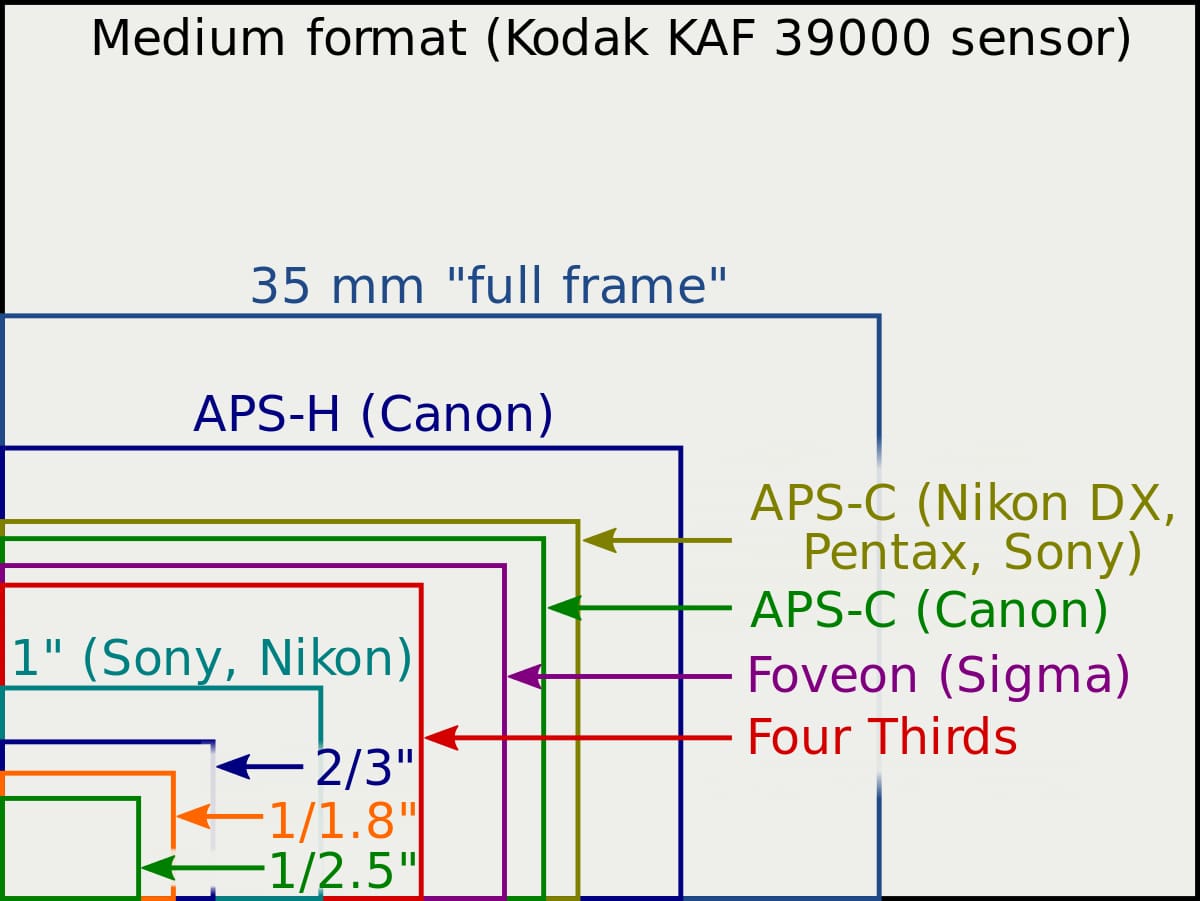
Comparative sizes of various digital camera image sensor formats, from medium format down to smaller point-and-shoot sensors.
Physical Sensor Specifications and Area Metrics
The physical dimensions of camera sensors vary dramatically across formats, creating significant differences in light-gathering capability and optical characteristics1,4,5. Sensor area directly correlates with photon collection efficiency, while diagonal measurements determine the image circle requirements for lens design6,7.
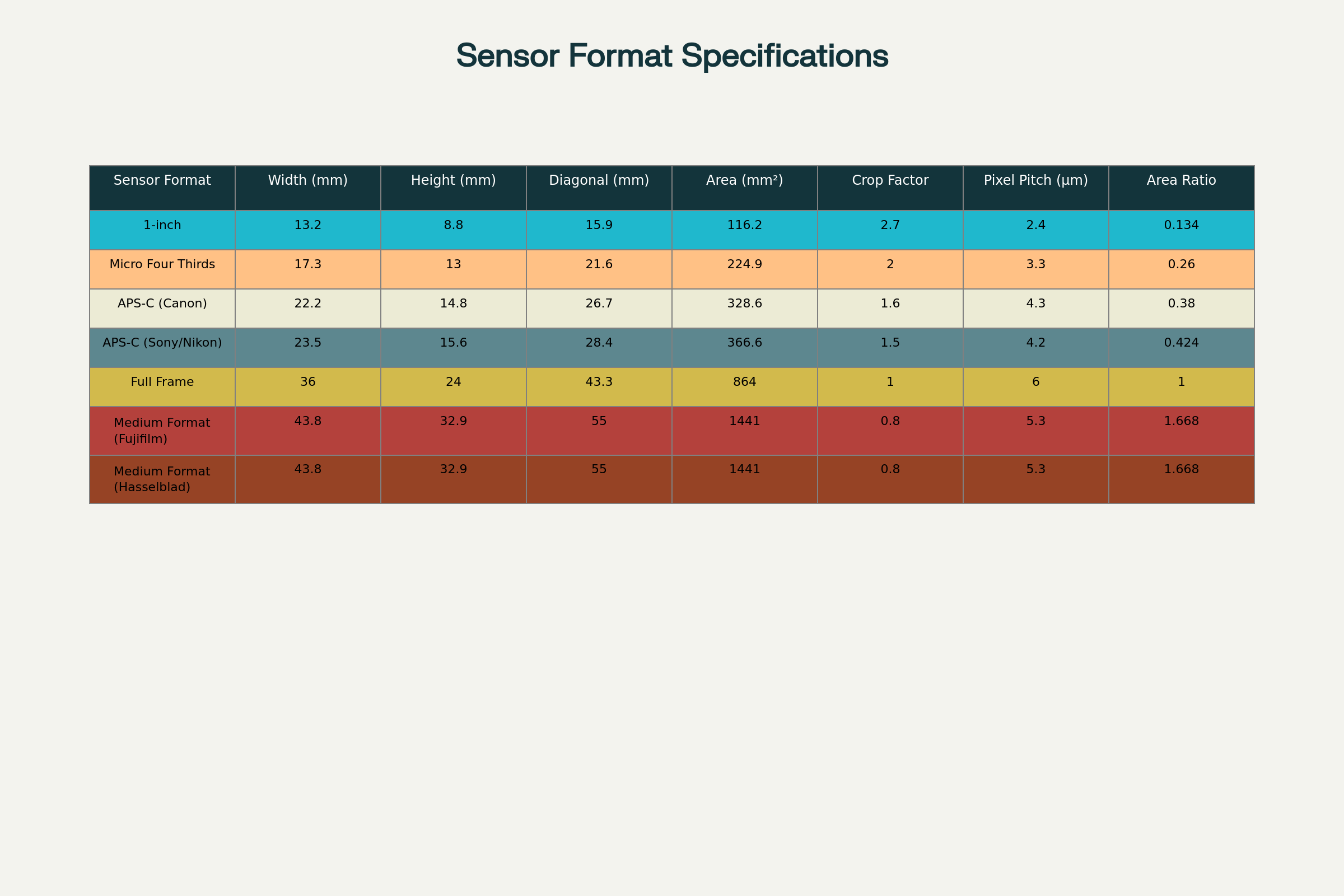
Camera Sensor Physical Specifications and Metrics Table
Medium format sensors lead in absolute size with dimensions of 43.8 × 32.9 mm, providing 1,441 mm² of active area and representing 167% of full-frame light-gathering capability8,9,10. Full-frame sensors, measuring 36.0 × 24.0 mm with 864 mm² area, serve as the reference standard with a 1.0× crop factor2,5,6. APS-C formats vary by manufacturer, with Canon implementing 22.2 × 14.8 mm sensors (328.6 mm²) and Sony/Nikon utilizing 23.5 × 15.6 mm variants (366.6 mm²), both providing 38-42% of full-frame light collection1,3,5.
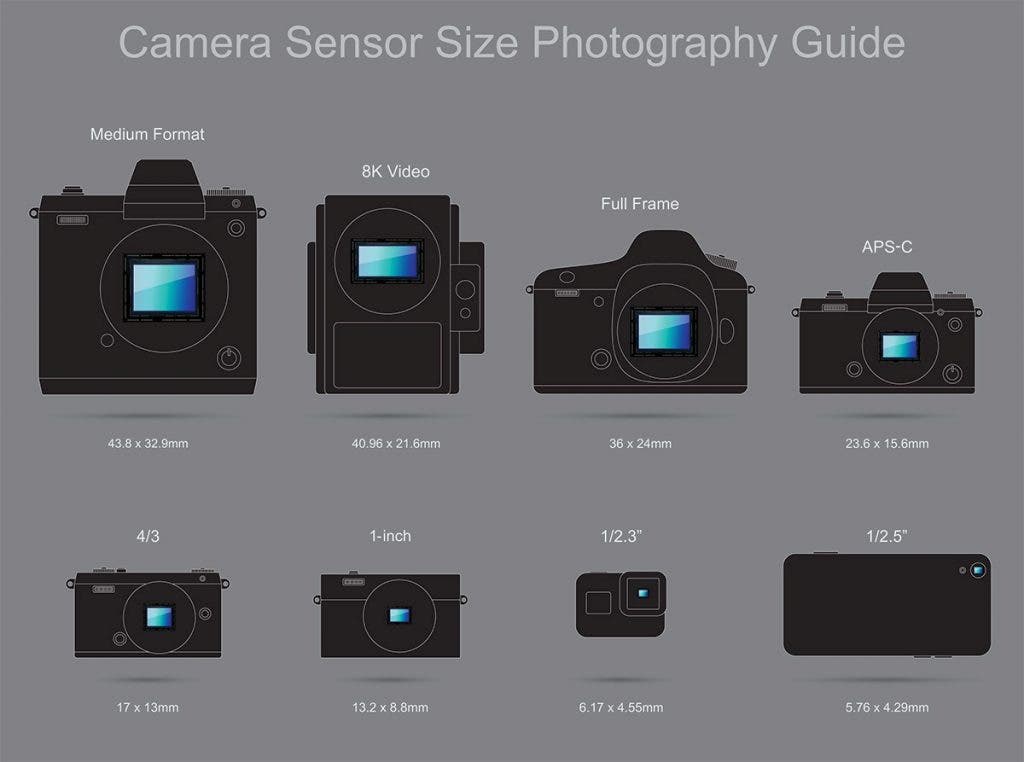
A visual guide illustrating the dimensions of various camera sensor sizes, including medium format, full-frame, APS-C, 4/3, and 1-inch sensors.
Micro Four Thirds sensors measure 17.3 × 13.0 mm (224.9 mm²) with a distinctive 4:3 aspect ratio, offering 26% of full-frame light-gathering capability5,8,11. The smallest format analyzed, 1-inch sensors at 13.2 × 8.8 mm (116.2 mm²), provide only 13.4% of full-frame light collection but enable ultra-compact camera designs4,5,8.
Pixel Pitch and Dynamic Range Performance Correlation
The relationship between pixel pitch and dynamic range reveals fundamental sensor design trade-offs12,13,14. Larger pixel pitch generally correlates with improved dynamic range performance due to increased photon collection capacity per photosite15,16,14.
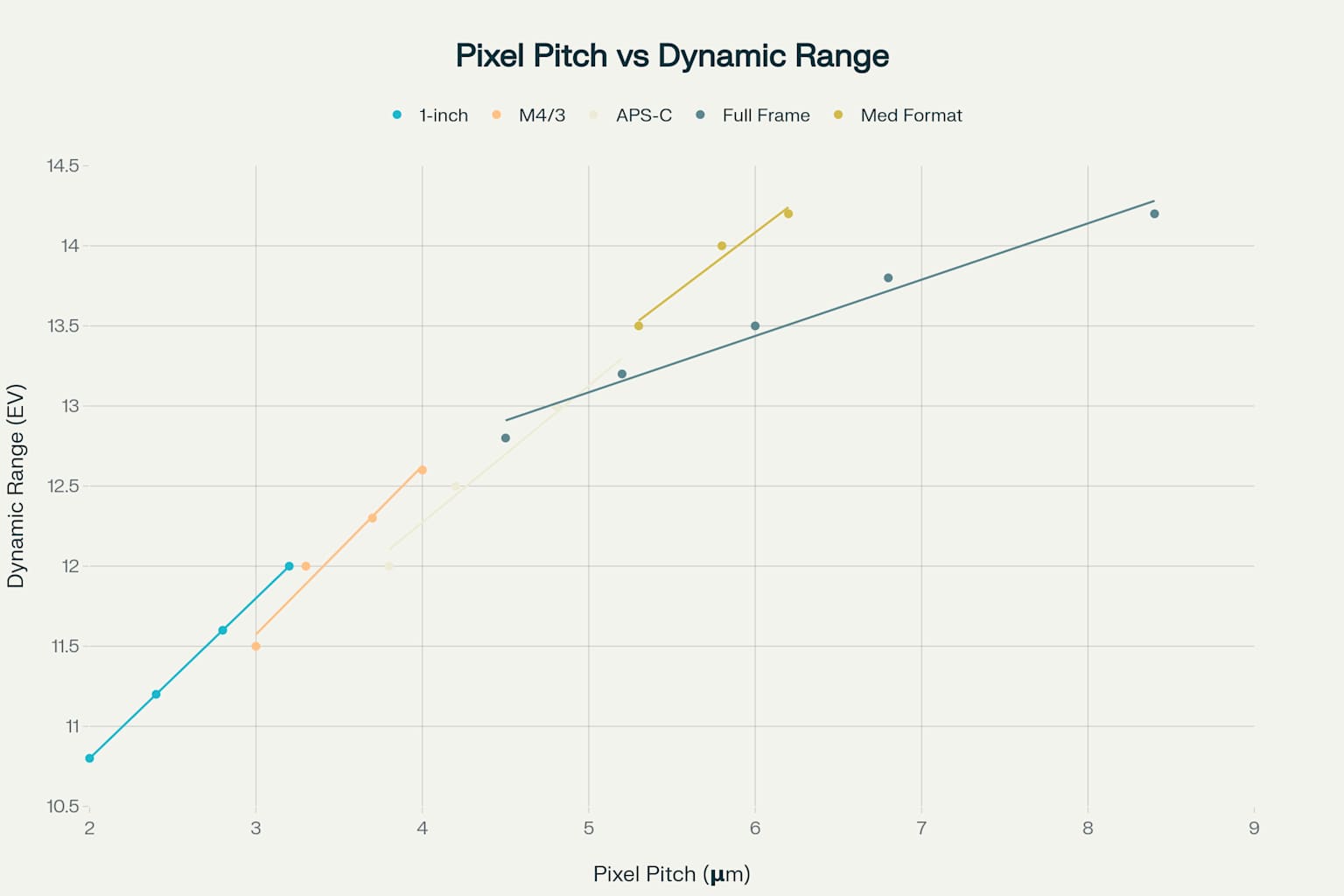
Pixel Pitch vs Dynamic Range Performance by Sensor Format
Analysis of contemporary sensors demonstrates clear performance stratification across formats13,14,17. Full-frame sensors with 6+ μm pixel pitch achieve dynamic ranges of 13.5-14.2 EV, with the Sony A7S III's 8.4 μm pixels delivering exceptional 14.2 EV performance18,17,19. Medium format sensors achieve 13.5-14.2 EV dynamic range despite smaller 5.3-6.2 μm pixels, benefiting from advanced manufacturing processes and larger total sensor area9,10.
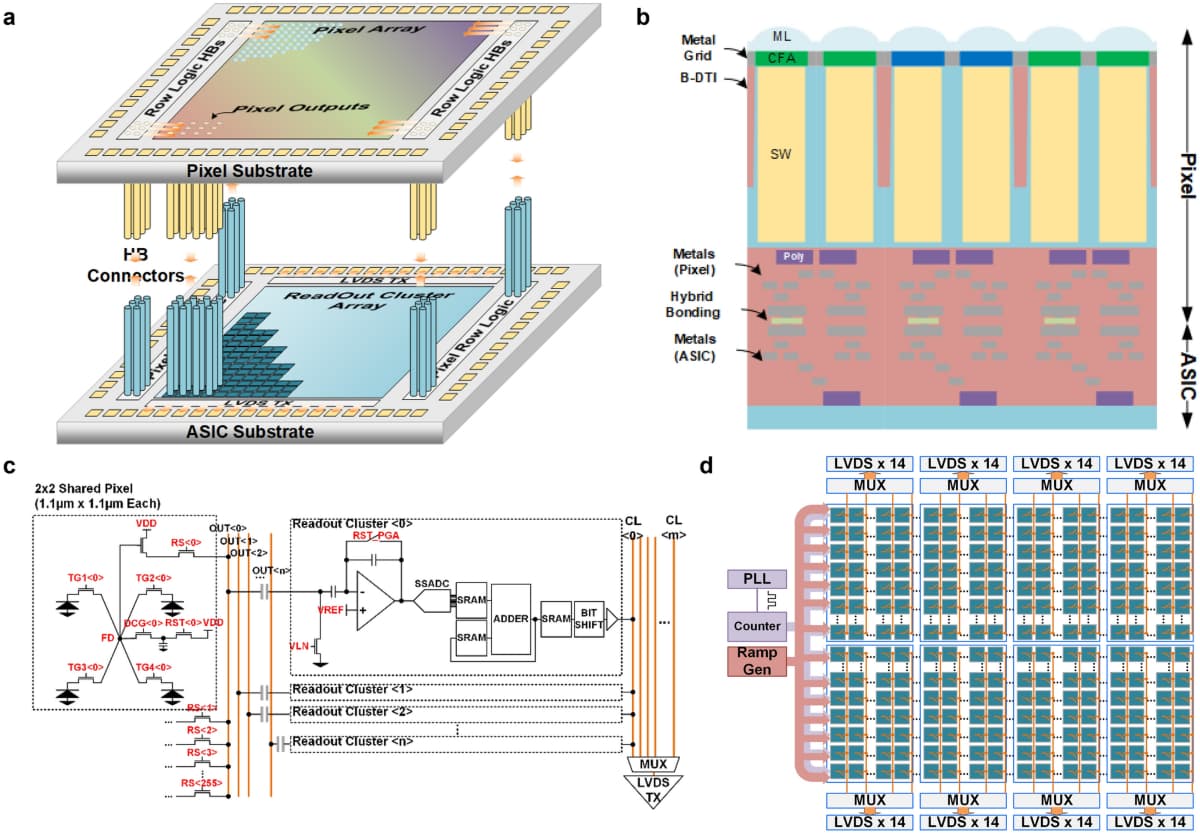
Detailed technical diagrams of a modern stacked image sensor, illustrating its 3D architecture, pixel cross-section, readout circuitry, and overall data path.
APS-C sensors demonstrate 12.0-13.2 EV dynamic range with 3.8-5.2 μm pixel pitch, while Micro Four Thirds achieves 11.5-12.6 EV with 3.0-4.0 μm pixels3,20,21. The smallest 1-inch sensors provide 10.8-12.0 EV dynamic range with 2.0-3.2 μm pixels, representing the most constrained performance category4,8,17.
High-ISO Image Quality Performance Rankings
High-ISO performance varies significantly across sensor formats, with larger sensors generally providing superior noise characteristics and usable sensitivity ranges22,17,23. Current generation sensors demonstrate substantial improvements in low-light capabilities compared to previous technologies24,17,25.
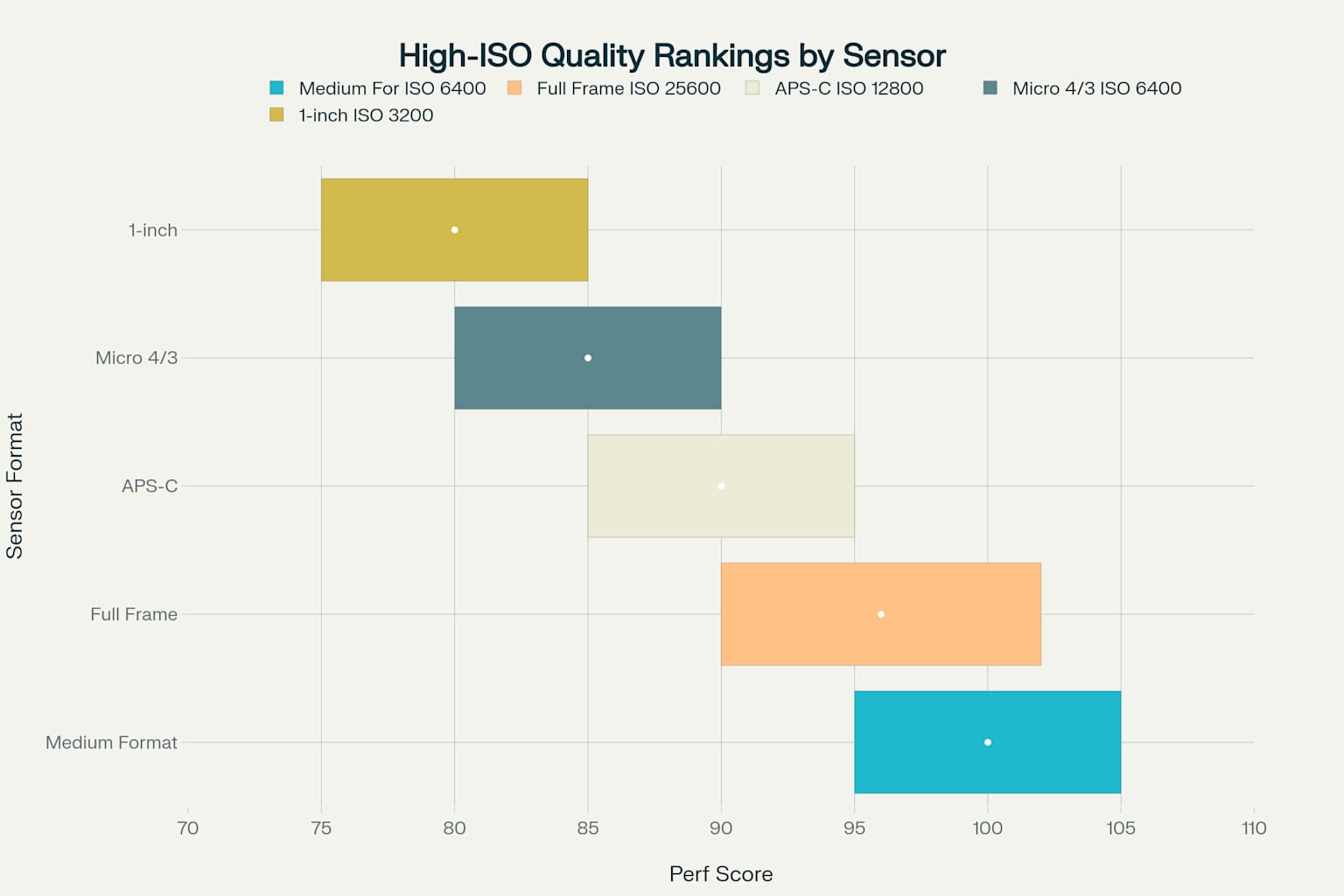
High-ISO Image Quality Performance Rankings by Sensor Format
Full-frame sensors lead in high-ISO performance with usable sensitivities extending to ISO 25,600, exemplified by cameras like the Sony A7S III and Canon R6 Mark II22,17,23. The latest Canon EOS R1 represents the pinnacle of high-ISO performance in full-frame sensors, demonstrating superior noise characteristics up to ISO 25,600 while maintaining fine detail retention22. APS-C sensors provide excellent performance up to ISO 12,800, with models like the Sony A6700 and Fujifilm X-S20 delivering professional-grade results17,26,23.
Medium format sensors, despite their larger physical size, typically limit usable ISO to 6,400 due to smaller pixel pitch and optimization for maximum resolution rather than low-light performance9,10. Micro Four Thirds sensors achieve ISO 6,400 usability through advanced noise reduction algorithms and back-side illuminated sensor designs11,17,26. 1-inch sensors generally limit usable performance to ISO 3,200, though premium implementations like the Sony RX100 VII extend this slightly17.
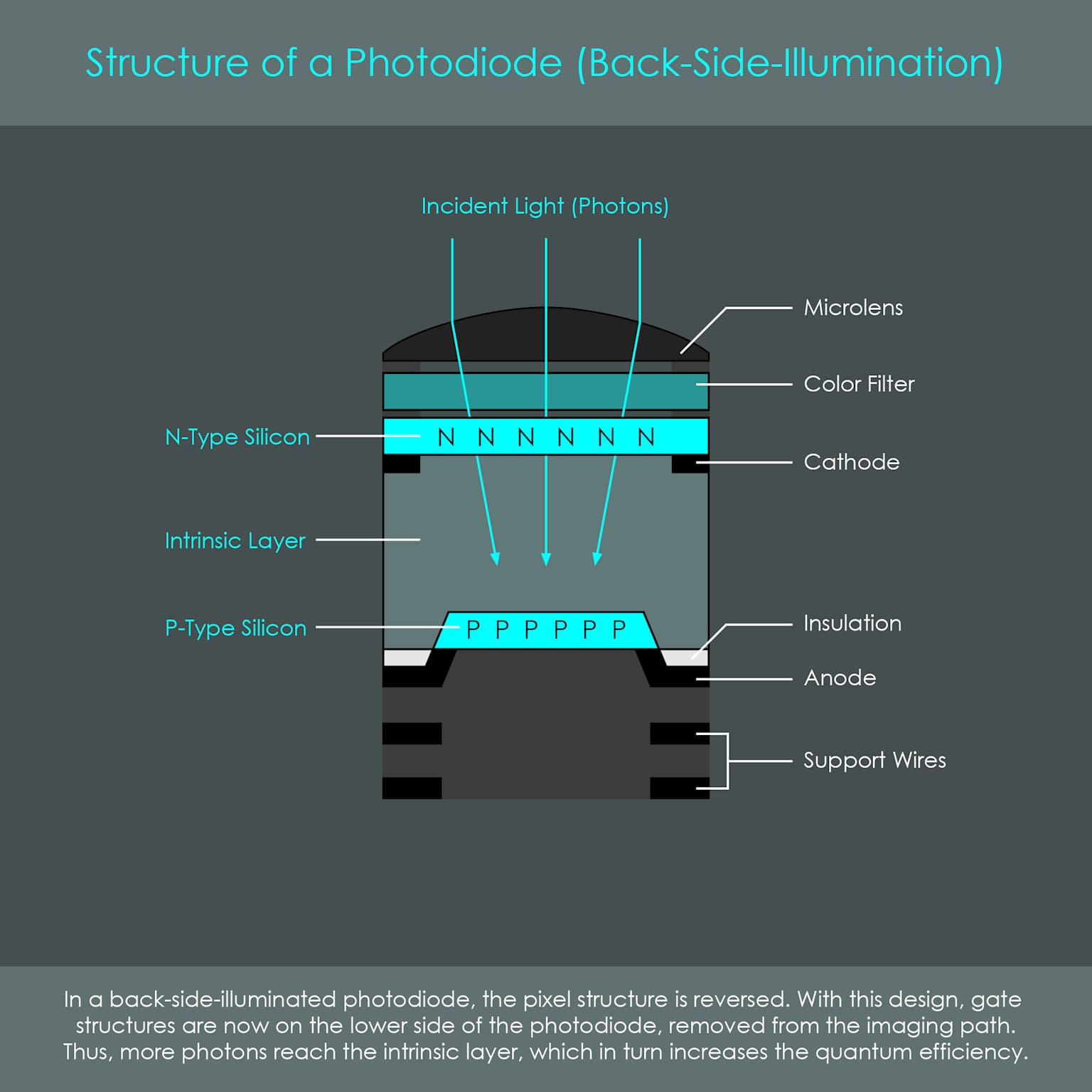
Diagram of a back-side-illuminated photodiode, illustrating its internal structure and the path of incident light for photon capture.
Cost Distribution and Market Positioning Analysis
Camera body pricing reflects the technical complexity and target market positioning of different sensor formats27,28,20. Cost structures demonstrate clear market segmentation based on sensor size and intended user demographics9,10.
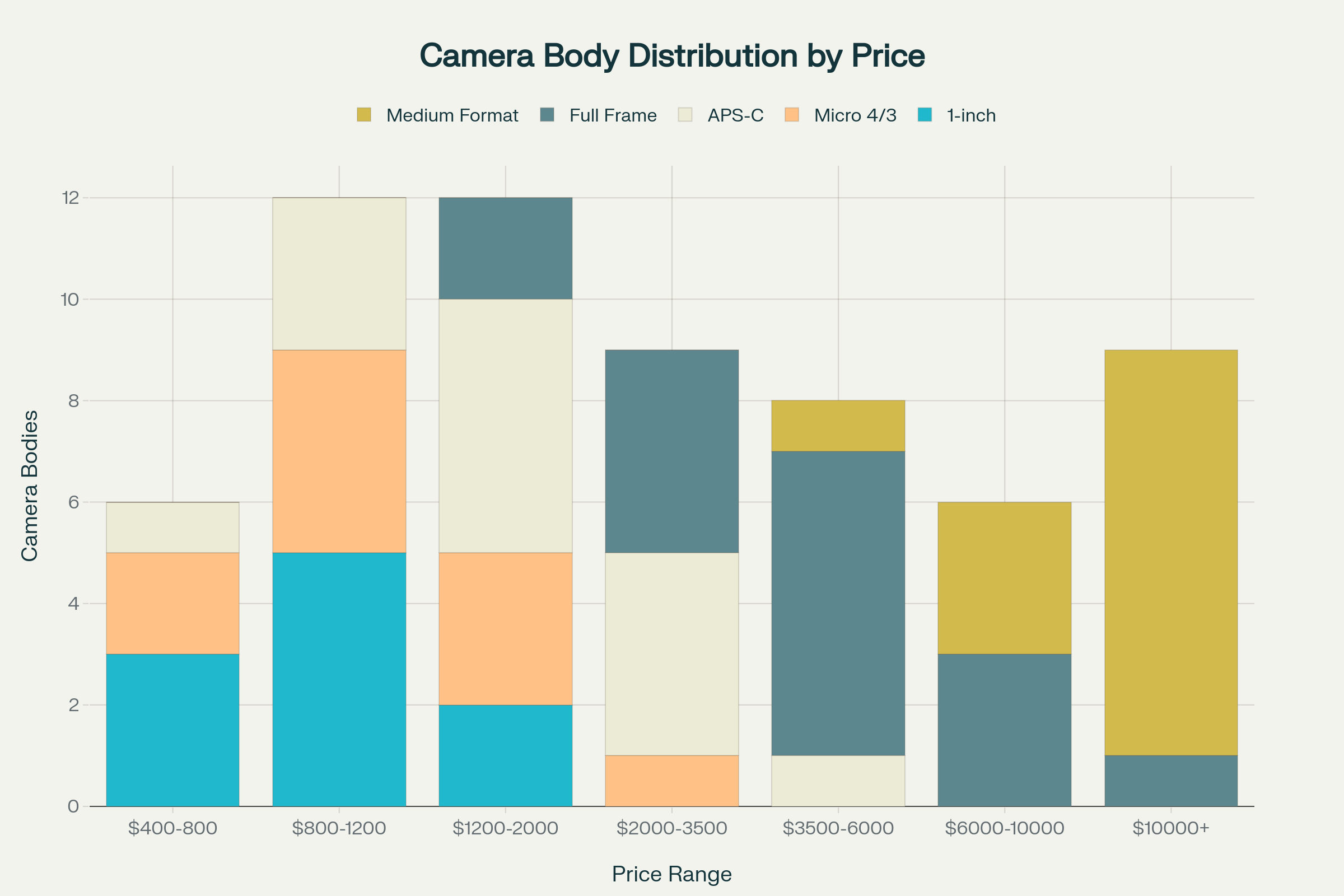
Camera Body Count Distribution by Price Range and Sensor Format
Entry-level pricing varies dramatically across formats, with Micro Four Thirds offering the most accessible professional-grade imaging at $600 entry levels28,11. APS-C and 1-inch sensors typically start at $800, while full-frame systems begin at $1,50027,20,17. Medium format represents the premium segment with entry prices starting at $4,0009,10.
Professional body pricing shows even greater stratification, with medium format systems reaching $15,000+ for flagship models like the Hasselblad X-series9,10. Full-frame professional bodies typically cost $4,000, while APS-C professional systems reach $2,00027,28,20. The cost distribution analysis reveals that medium format dominates the ultra-premium $10,000+ market segment, while full-frame systems cluster in the $3,500-6,000 professional range9,10,23.
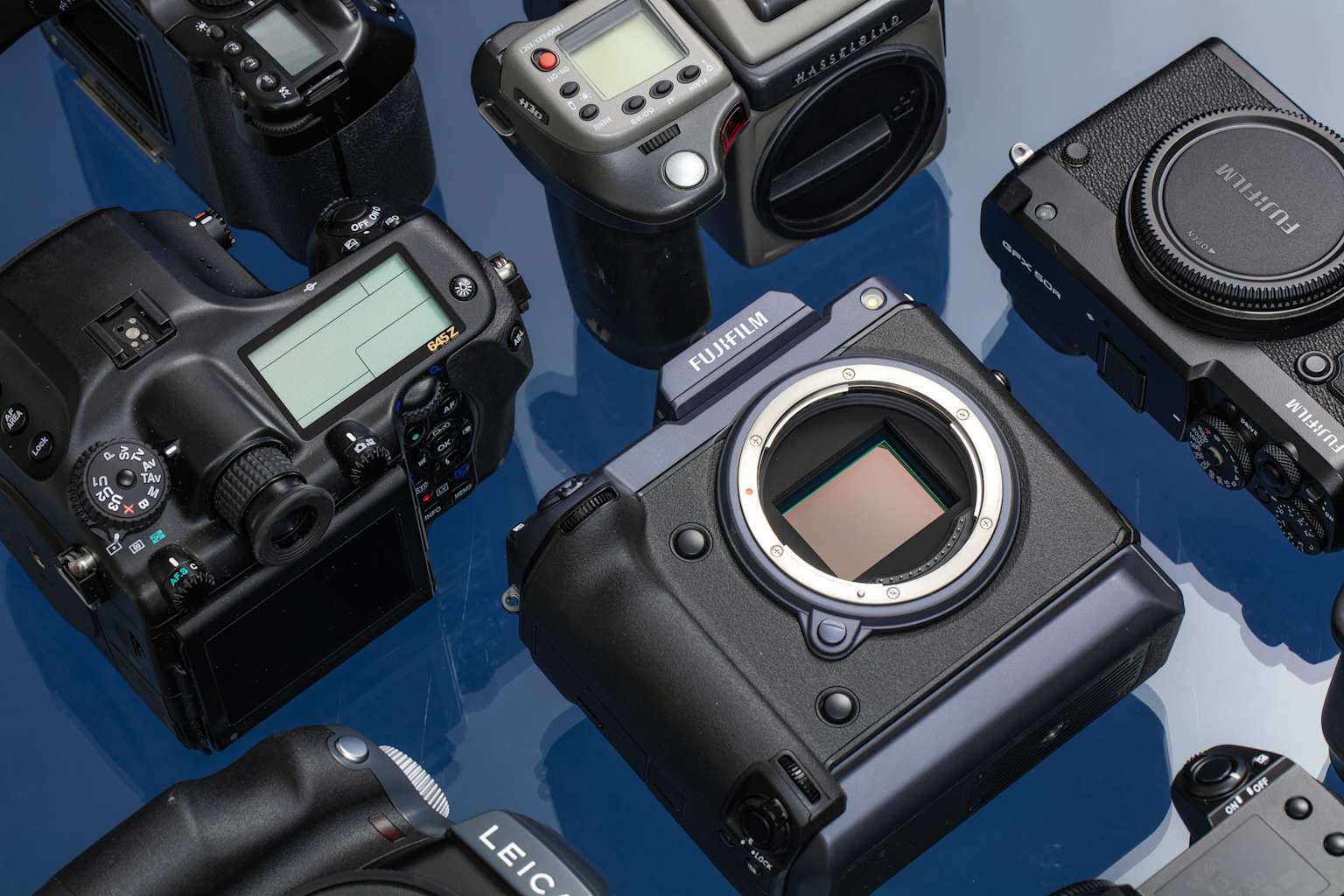
A collection of high-end camera bodies, including Pentax, Hasselblad, Fujifilm, and Leica models, showcasing professional medium format equipment.
Application-Specific Performance Analysis
Different sensor formats excel in specific photographic applications based on their inherent characteristics and optical properties29,30. Understanding these strengths enables optimal format selection for particular use cases31,32,33.
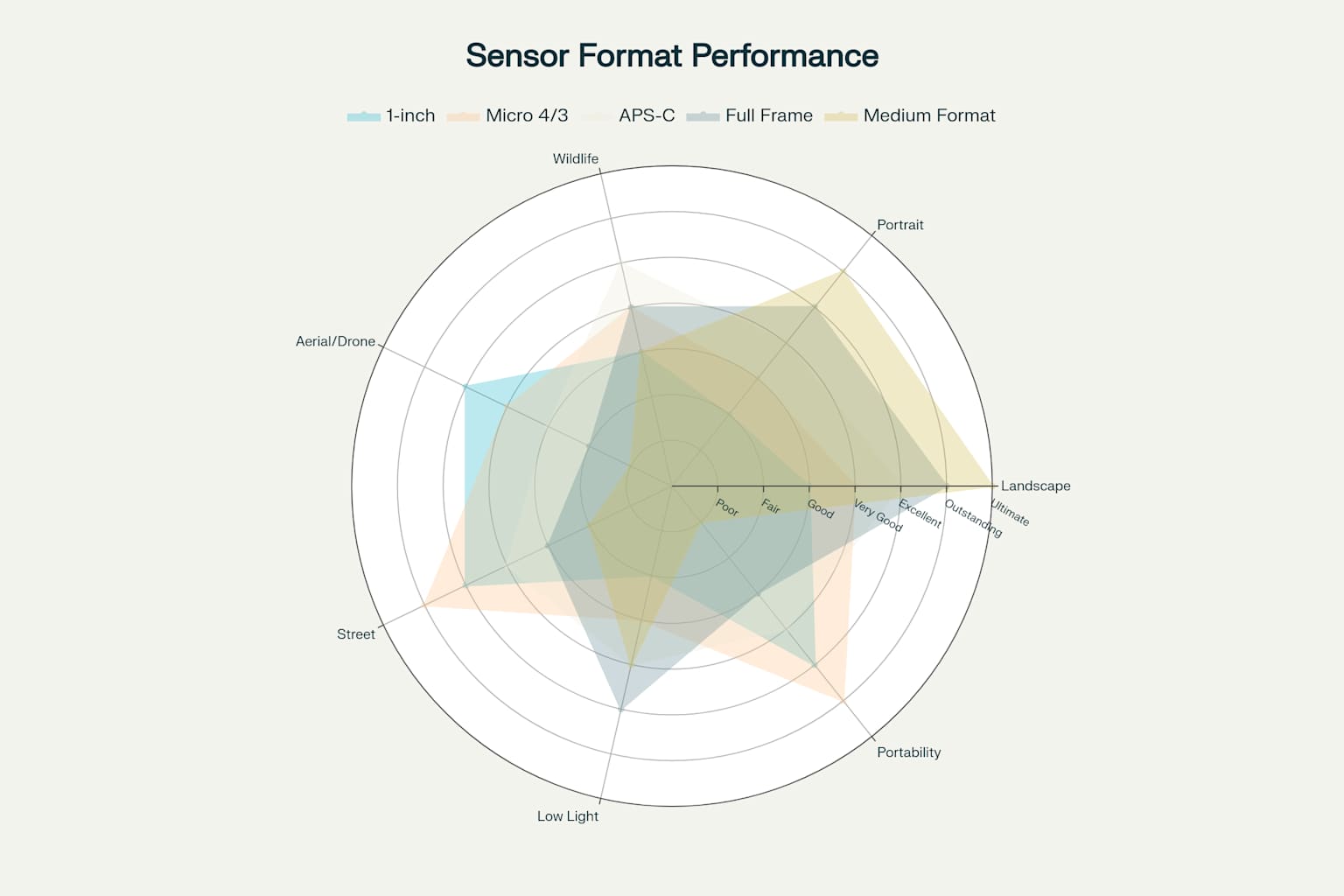
Best-Fit Applications Analysis by Sensor Format
Landscape Photography Applications
Medium format sensors provide ultimate landscape performance through maximum resolution and dynamic range capabilities30. The 14.0 EV dynamic range enables superior highlight and shadow detail retention in high-contrast scenes9,10. Full-frame sensors offer outstanding landscape performance with excellent balance of resolution, dynamic range, and lens selection23.
APS-C sensors deliver excellent landscape results with good value proposition, while the crop factor can provide additional reach for distant subjects20,21. Micro Four Thirds offers very good performance in a compact package, particularly advantageous for hiking and travel landscapes11. 1-inch sensors provide adequate landscape capability in ultraportable cameras but with limitations in dynamic range and detail resolution17.
Portrait and Studio Photography
Medium format dominates professional portrait applications through exceptional resolution and natural shallow depth-of-field characteristics9,10,30. The larger sensor area enables superior background separation and micro-contrast rendition30. Full-frame sensors provide excellent portrait performance and remain the professional standard for wedding and event photography17,23,19.
APS-C sensors offer very good portrait capabilities with affordable lens options, though achieving extremely shallow depth-of-field requires wider apertures20,21. Micro Four Thirds provides good portrait performance for most applications, with the deeper depth-of-field sometimes advantageous for group portraits11. 1-inch sensors offer limited shallow depth-of-field capability, restricting creative portrait options17.
Wildlife and Sports Photography
APS-C sensors excel in wildlife photography through the crop factor advantage, effectively extending telephoto reach while maintaining fast autofocus systems20,21,17. The smaller sensor size enables lighter, more affordable telephoto lenses with equivalent field-of-view26,23. Full-frame sensors provide very good wildlife performance with superior low-light capability but at increased size and cost17,23.
Micro Four Thirds offers very good wildlife performance with the most compact telephoto lens options available11,17. Medium format systems provide exceptional resolution for wildlife but typically feature slower autofocus unsuited for action photography9,10. 1-inch sensors enable wildlife photography in ultra-compact cameras but with limited low-light performance17.
Aerial and Drone Applications
1-inch sensors represent the optimal choice for aerial photography, providing the best balance of image quality and size/weight constraints17. The compact form factor enables extended flight times while delivering adequate image quality for most applications4,8. Micro Four Thirds offers very good aerial performance where payload capacity permits larger systems11.
APS-C sensors provide good aerial image quality but require larger, more expensive drone platforms20. Full-frame systems face significant size and weight penalties for aerial applications, limiting their practical implementation. Medium format sensors prove largely impractical for drone applications due to size, weight, and power requirements.
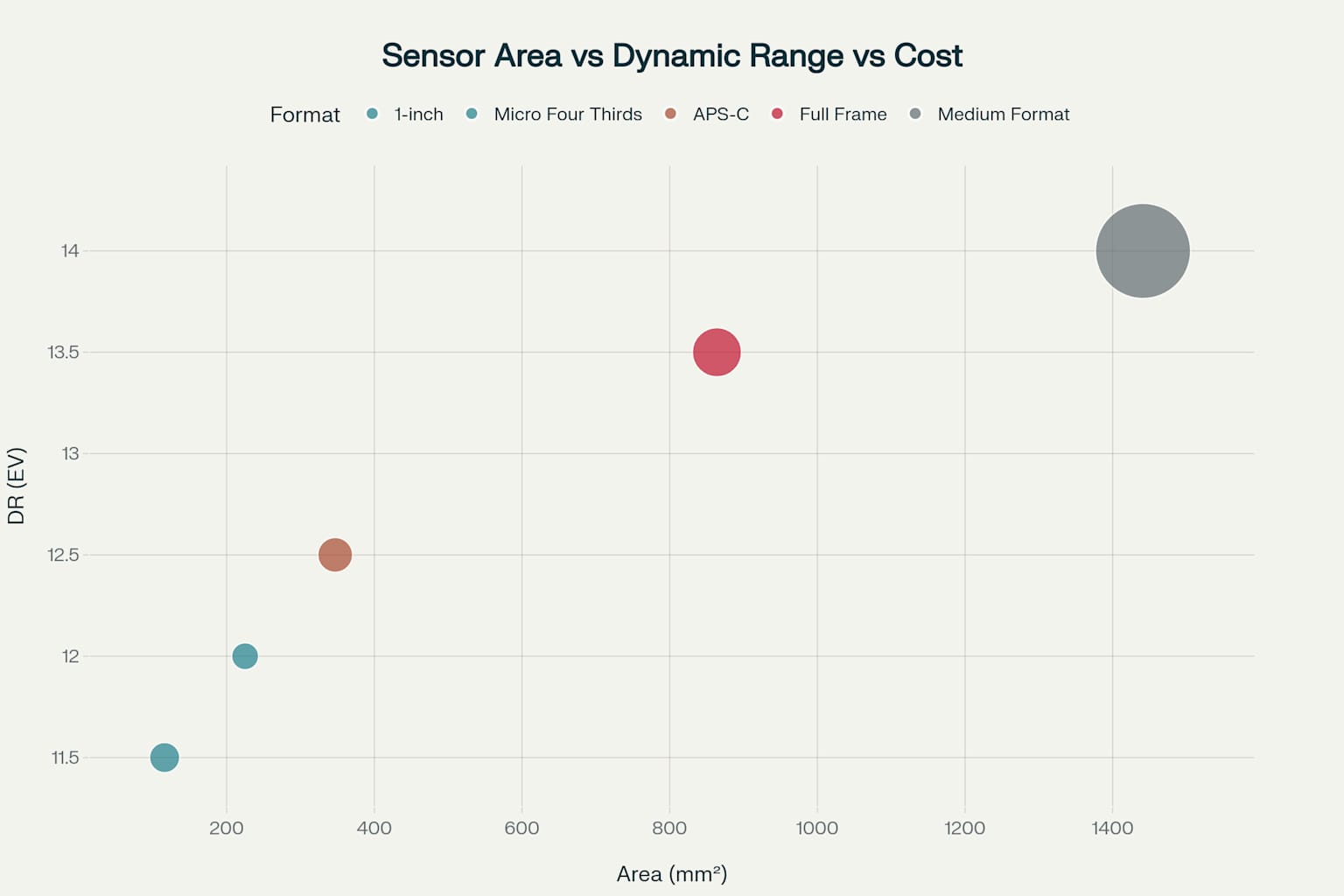
Sensor Area vs Dynamic Range vs Cost Analysis
Street and Documentary Photography
Micro Four Thirds excels in street photography through outstanding portability and discrete operation capabilities11,17. The compact system size enables unobtrusive documentation while maintaining professional image quality11. 1-inch sensors provide excellent street photography capability in ultra-compact cameras that attract minimal attention17.
APS-C sensors offer very good street performance with balanced size and quality characteristics20,21. Full-frame systems provide good image quality but increased size may compromise discrete operation17,23. Medium format systems generally prove too conspicuous for street photography applications9,10.
Performance Summary and Comparison Matrix
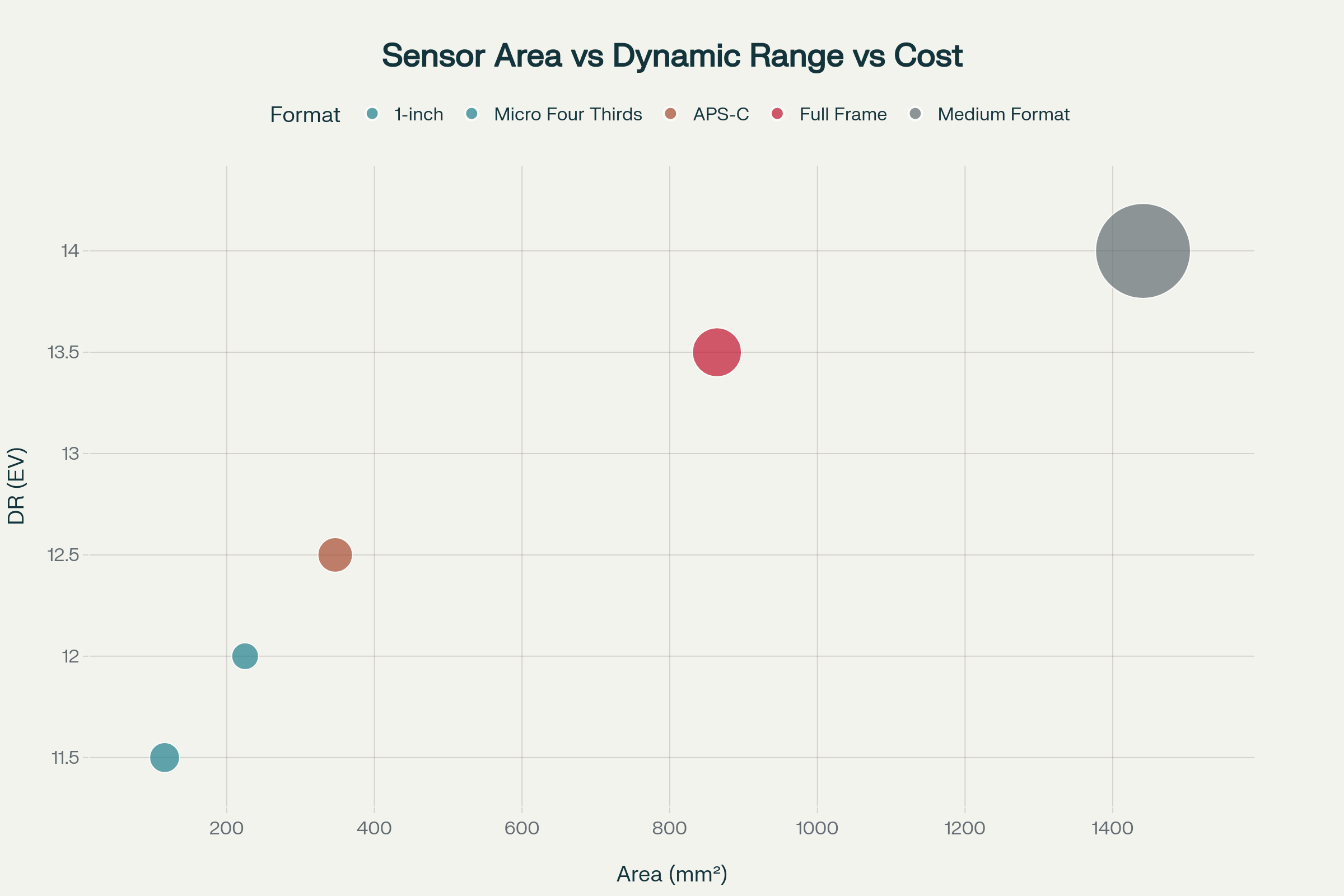
Comprehensive sensor format comparison showing the relationship between cost, performance, and size
| Format | Resolution | Dynamic Range | ISO Performance | Portability | Cost | Best Use Cases |
|---|---|---|---|---|---|---|
| Medium Format | Excellent (100MP+) | Excellent (14.0 EV) | Good (ISO 6,400) | Poor | Very High | Studio, Fashion, Architecture |
| Full Frame | Very Good (24-61MP) | Very Good (13.5 EV) | Excellent (ISO 25,600) | Fair | High | Professional All-around |
| APS-C | Good (16-32MP) | Good (12.5 EV) | Very Good (ISO 12,800) | Good | Medium | Wildlife, Sports, Travel |
| Micro 4/3 | Good (16-25MP) | Good (12.0 EV) | Good (ISO 6,400) | Excellent | Low-Medium | Travel, Street, Video |
| 1-inch | Fair (12-20MP) | Fair (11.5 EV) | Fair (ISO 3,200) | Excellent | Low | Compact, Drone, Casual |
Technical Performance Integration and Future Considerations
The comprehensive analysis reveals clear performance hierarchies and application-specific optimization strategies across sensor formats13,34,14. Medium format sensors provide ultimate image quality for specialized professional applications, while full-frame maintains the professional standard for versatile imaging9,10,17. APS-C delivers excellent value and performance for enthusiast and semi-professional applications20,21,26.
Micro Four Thirds offers outstanding portability with good image quality, particularly suited for travel and documentary work11,17. 1-inch sensors enable ultra-compact professional capability for specialized applications like aerial photography and discrete documentation4,17.
Emerging technologies including back-side illuminated sensors, stacked sensor architectures, and advanced noise reduction algorithms continue to improve performance across all formats22,35,25. These developments particularly benefit smaller sensor formats, gradually closing the performance gap with larger alternatives while maintaining size and cost advantages35,24,25.
The selection of optimal sensor format ultimately depends on the specific balance of image quality requirements, portability needs, budget constraints, and intended applications17,23. Understanding these trade-offs enables informed decision-making for both professional and enthusiast photographers across diverse imaging scenarios1,2,3.
References:
- Understanding Camera Sensor Sizes
- Image Sensor Format - Wikipedia
- Camera Sensor Size Guide
- CMOS Sensor Size Analysis
- Camera Sensor Size Fundamentals
- Sony A7R IV Specifications
- Sensor Diagonal Calculations
- Camera Sensor Sizes Explained
- Medium Format Camera Comparison
- Affordable Medium Format Cameras
- Micro Four Thirds vs Full Frame
- Pixel Pitch Explained
- Sony A9 III Sensor Analysis
- Digital Camera Sensitivity
- Pixel Pitch Fundamentals
- Pixel Size and Resolution
- Best High ISO Cameras
- Pixel Pitch Database
- Camera Low Light Performance
- Best Cameras Around $2000
- Camera Format Comparison
- Canon EOS R1 High ISO Performance
- Camera Performance Analysis