1.01 Mirrorless vs DSLR: Architecture, Performance & Ecosystem Complete Analysis
A comprehensive analysis of the definitive technological and commercial shift from DSLR to mirrorless cameras, examining architectural differences, performance metrics, ecosystem dynamics, and future innovations spanning 2020-2025.
Mirrorless vs DSLR: A Comprehensive Analysis of Architecture, Performance, and Ecosystem (2020-2025)
Executive Summary
The digital interchangeable-lens camera market has undergone a seismic technological and commercial shift over the past decade, culminating in the definitive ascendancy of the mirrorless architecture over the Digital Single-Lens Reflex (DSLR). This comprehensive analysis provides an exhaustive examination of this transition, dissecting the foundational architectural differences between the two platforms and tracing their profound impact on performance, physical design, and the trajectory of innovation.
The core schism lies in a single component: the reflex mirror. Its presence in the DSLR, a legacy of film-era design, is the root cause of its inherent limitations in speed, size, and autofocus sophistication. The removal of this mirror is not merely an incremental improvement but a fundamental re-architecting of the camera into a solid-state computational device.
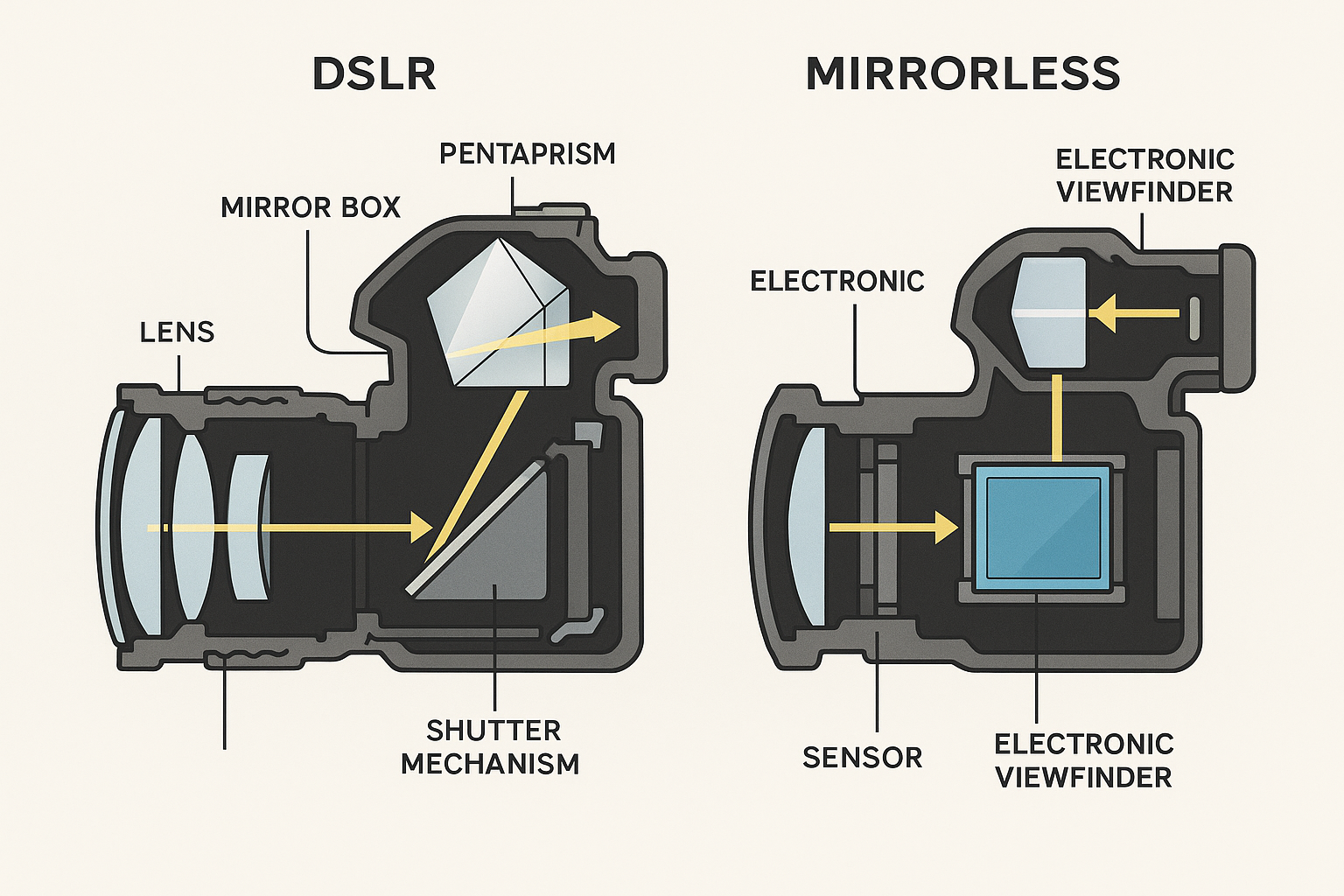
DSLR vs Mirrorless Camera Internal Architecture: The fundamental difference in light path design
This analysis demonstrates that the performance gap between mirrorless and DSLR systems is not only wide but accelerating. Mirrorless cameras, unencumbered by mechanical constraints, leverage on-sensor phase-detection autofocus (PDAF), advanced image processors, and AI-driven subject recognition to achieve levels of speed and tracking accuracy that are unattainable by DSLRs. Flagship mirrorless models now offer blackout-free continuous shooting at rates of 30, 40, or even 120 frames per second, while the most advanced DSLRs reached their mechanical performance ceiling years ago.
The ecosystem surrounding these platforms reflects this technological divergence. While DSLR systems boast a vast and affordable legacy lens market, all significant research and development from major manufacturers is now exclusively channeled into their native mirrorless lens mounts. This has created a vibrant ecosystem of optically superior lenses that capitalize on the design freedoms afforded by the shorter flange-back distance of mirrorless bodies.
Market data corroborates this industry-wide pivot, with mirrorless cameras now commanding 41.2% of the global market share compared to DSLR's diminishing presence. Forward-looking innovations such as stacked CMOS sensors, global shutters, and advanced computational photography techniques are exclusively the domain of the mirrorless platform.
1. Foundational Architecture: The Divergence of Light Paths and Design Philosophy
The essential difference between a Digital Single-Lens Reflex (DSLR) camera and a mirrorless camera is captured in their names. It is the presence or absence of a reflex mirror mechanism that dictates the core architecture, creating two fundamentally distinct design philosophies.
1.1 The DSLR Paradigm: The Reflex Mirror and the Optical Viewfinder (OVF)
The DSLR is a direct descendant of the 35mm film SLR, inheriting its core mechanical principle: using a single lens for both composing the image and capturing it. This is achieved through an intricate system of mirrors and prisms that defines the camera's operation and its physical form.
1.1.1 Schematic Breakdown of the DSLR Light Path
The light path in a DSLR is a two-stage process, determined by whether the user is composing a shot or capturing it:
Composition (Pre-Exposure): When the photographer looks through the eyepiece, light travels from the subject through the lens elements. It then strikes a main reflex mirror, which is angled at 45 degrees inside a chamber known as the mirror box. This mirror reflects the light vertically upwards into a focusing screen and then into a pentaprism (or a less expensive pentamirror in entry-level models). The pentaprism is a five-sided optical block that corrects the orientation of the image, which would otherwise be upside down and reversed left-to-right, presenting a true, correctly oriented optical view to the photographer's eye through the viewfinder.
Simultaneously, a portion of the light passes through a semi-transparent section of the main mirror to a smaller, secondary mirror, which reflects it downwards into a dedicated phase-detection autofocus (PDAF) sensor located in the base of the camera.
Capture (During Exposure): When the shutter button is fully depressed, a rapid sequence of mechanical events occurs. The main mirror and the secondary mirror flip up and out of the light path, momentarily blacking out the viewfinder. This clears a direct path for the light to travel past the now-open focal-plane shutter and strike the digital image sensor, where the image is recorded. After the exposure is complete, the shutter closes and the mirror assembly drops back down into its 45-degree position, restoring the view through the OVF.
1.1.2 Component Analysis
The defining components of the DSLR architecture are all related to managing this dual light path:
The Mirror Box: This is the physical housing for the mirror-flipping mechanism. It is a marvel of mechanical engineering, but its very existence dictates the camera's size and introduces several limitations. The space required for the mirror to flip up and down necessitates a significant distance between the lens mount and the image sensor, known as the flange-back distance. This mechanical action is also a source of noise and micro-vibrations ("mirror slap"), which can be detrimental in quiet environments or when using slower shutter speeds.
The Pentaprism/Pentamirror: High-end and professional DSLRs use a solid glass pentaprism, which is heavy but transmits a bright, clear image to the viewfinder. To reduce cost and weight, consumer-grade DSLRs often use a hollow pentamirror, which uses a series of reflective surfaces to achieve the same image correction but results in a noticeably dimmer viewfinder image.
The Optical Viewfinder (OVF): The primary user interface for composition in a DSLR is the OVF. Its main advantage is providing a true, unmediated, zero-latency optical view of the world. For many photographers, especially those shooting wildlife or sports, this direct connection to the scene is a significant benefit, as there is no digital processing or lag between the subject's action and what is seen in the viewfinder.
However, the OVF has a critical drawback: it does not accurately represent the final image. Because the sensor is not active during composition, the OVF cannot display how changes to exposure, white balance, or picture style will affect the final shot. The photographer must take a picture and review it on the rear LCD screen to confirm these settings—a process often called "chimping".
1.2 The Mirrorless Revolution: A Direct-to-Sensor Architecture
Mirrorless cameras, as the name implies, eliminate the entire mirror box and pentaprism assembly. This seemingly simple change represents a fundamental paradigm shift, moving from a primarily mechanical system to a fully electronic one.
1.2.1 Schematic Breakdown of the Mirrorless Light Path
The light path in a mirrorless camera is singular and direct. Light passes through the lens and falls directly onto the image sensor at all times. The sensor continuously reads this light information and sends a live digital feed to the camera's image processor. The processor then relays this feed to be displayed on either the rear LCD screen or a high-resolution electronic viewfinder (EVF) located where the OVF would be on a DSLR. When the shutter button is pressed, the camera simply records the data from the sensor for the duration of the exposure.
1.2.2 Component Analysis
The removal of the mirror redefines the roles of the camera's core components:
The Image Sensor as the Core: In a mirrorless system, the image sensor is the central hub of operation. It is no longer just a passive recording medium used only during the final exposure; it is an active component responsible for providing the live view for composition, executing on-sensor autofocus, and capturing the final image. This "always-on" state of the sensor and its associated processing is the primary reason mirrorless cameras historically have shorter CIPA-rated battery life than DSLRs.
The Electronic Viewfinder (EVF): The EVF is a miniature, high-resolution display (typically OLED or high-density LCD) viewed through a series of magnifying optics. The key advantage of the EVF is its "What You See Is What You Get" (WYSIWYG) nature. Because it displays a direct feed from the image sensor, it can show a real-time preview of the final image, complete with the effects of exposure settings, white balance, picture styles, and true depth of field. This eliminates guesswork and allows the photographer to make creative decisions before pressing the shutter.
Modern EVFs in high-end cameras feature extremely high resolutions (e.g., 5.76 million to 9.44 million dots) and fast refresh rates (up to 240 fps) that have largely overcome the lag, low resolution, and blackout issues that plagued early models.
Shutter Mechanisms: All mirrorless cameras retain a mechanical focal-plane shutter for certain applications, such as mitigating banding under artificial lights or for flash photography. However, the absence of a mirror mechanism makes the integration of a fully electronic shutter (ES) far more practical and powerful. An electronic shutter simply involves turning the sensor's pixels on and off for a set duration. This allows for completely silent operation, which is invaluable for wedding, event, and wildlife photography. It also removes the mechanical speed limitations of a physical shutter, enabling incredibly fast continuous shooting speeds (e.g., 30, 40, or even 120 fps) and extremely high shutter speeds (e.g., 1/32,000s or faster).
1.3 Architectural Consequences: Form Factor, Ergonomics, and Lens Design
The decision to remove the reflex mirror has cascading effects that extend beyond the camera's internal workings, fundamentally reshaping the entire system's design potential.
The Flange-Back Advantage: The single greatest consequence of the mirrorless design is the dramatic reduction in the flange-back distance. With no mirror box to accommodate, the lens mount can be placed much closer to the image sensor. For example, Canon's DSLR EF mount has a flange distance of 44 mm, while its mirrorless RF mount has a distance of just 20 mm. Nikon's F-mount is 46.5 mm, while its Z-mount is a mere 16 mm.
Impact on Body Design: This shortened flange distance is the primary enabler of the smaller and lighter camera bodies that are a hallmark of mirrorless systems. By eliminating the bulky pentaprism and deep mirror box, manufacturers can create bodies that are significantly more compact than their DSLR counterparts with the same sensor size.
Unlocking Optical Innovation: The short flange distance is a liberation for optical engineers. DSLR wide-angle lenses required complex "retrofocus" designs, which use additional lens elements to push the optical center forward, ensuring the rear element of the lens would clear the swinging mirror. This added complexity, cost, and potential for optical compromises. With the short flange distance of mirrorless mounts, lens designers have far more freedom, leading to designs that are often sharper, especially in the corners, lighter, more compact, and capable of wider maximum apertures.
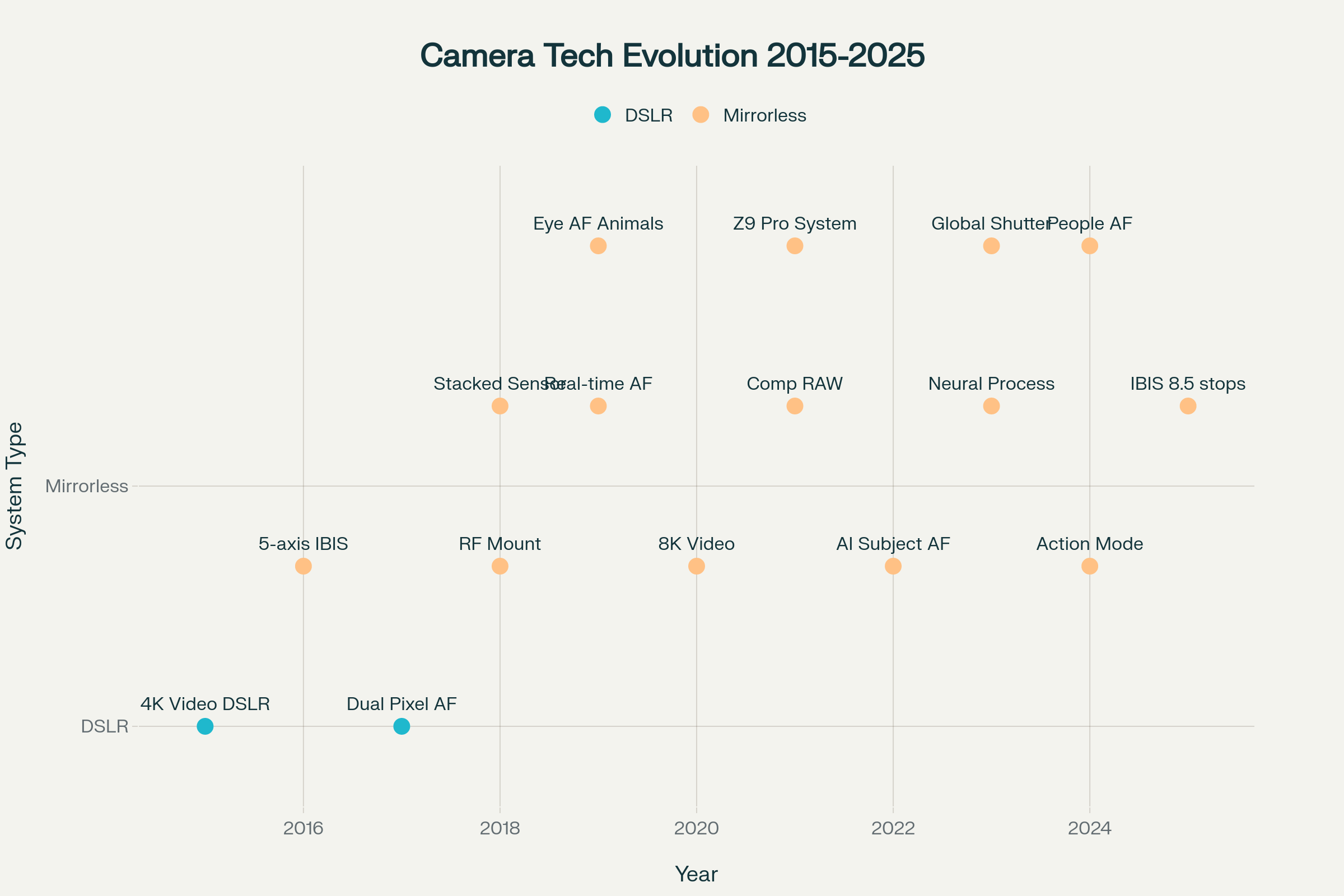
Camera Technology Innovation Timeline: DSLR vs Mirrorless (2015-2025)
The architectural foundation of the DSLR, the reflex mirror, was a brilliant solution for the film era. However, in the digital age, it has become the system's primary constraint. It dictates a larger body size, imposes limits on speed and silence, and creates a disconnect between what the photographer sees and what the sensor captures. The mirrorless architecture, by eliminating this single component, does not just solve one problem; it simultaneously resolves issues of size, speed, viewfinder accuracy, and lens design limitations.
2. Performance Benchmarking: Quantifying the Technological Divide (2020-2025)
The architectural differences between DSLR and mirrorless systems translate directly into quantifiable performance gaps. The period from 2020 to 2025 marks the era where these gaps widened into a chasm, particularly in the critical areas of autofocus and speed.
2.1 Autofocus Systems: From Dedicated Modules to On-Sensor Intelligence
Autofocus performance is perhaps the most dramatic illustration of the mirrorless advantage. The two systems employ fundamentally different methods for acquiring focus, and the mirrorless approach has proven to be vastly more powerful and flexible.
2.1.1 DSLR Autofocus: The Limits of Off-Sensor PDAF
DSLRs rely on a dedicated phase-detection autofocus (PDAF) sensor located in the base of the camera body. Light is diverted to this sensor by a secondary mirror positioned behind the main reflex mirror. This system, while fast for viewfinder-based shooting, suffers from several inherent limitations:
Limited Coverage: The AF points are physically constrained to a relatively small area in the center of the frame. This forces photographers to use a "focus-and-recompose" technique for off-center subjects, which can lead to focusing errors, especially with wide apertures.
Calibration Requirement: Because the imaging sensor and the AF sensor are two separate components, minute misalignments can lead to systematic front- or back-focusing issues. This often requires users to perform tedious AF micro-adjustments for each of their lenses to ensure critical sharpness.
Live View Inefficiency: The dedicated PDAF module is completely useless when the mirror is flipped up for Live View or video recording. In these modes, the DSLR must fall back on a much slower and less decisive contrast-detection autofocus (CDAF) system on the main image sensor.
2.1.2 Mirrorless Autofocus: The On-Sensor Revolution
Mirrorless cameras fundamentally solve the DSLR's AF problems by integrating the phase-detection autofocus pixels directly onto the surface of the main image sensor. This on-sensor PDAF approach provides transformative benefits:
Inherent Accuracy: Since the autofocus system and the imaging plane are one and the same, the possibility of front/back focus errors due to misalignment is eliminated. No calibration is required.
Near-Total Frame Coverage: AF points can be distributed across nearly 100% of the sensor's height and width, allowing for precise focus acquisition on subjects located anywhere in the frame without needing to recompose. Modern cameras like the Canon EOS R5 boast over 1,000 AF points covering the entire frame.
The AI and Processing Paradigm: This is the most significant advantage. Because the main image processor has a constant, high-speed data feed from the image sensor, it can apply immense computational power to the task of autofocus. Manufacturers now use sophisticated deep-learning AI algorithms to enable real-time subject recognition and tracking. Cameras can be trained to identify not just faces and eyes, but specific subjects like animals (birds, dogs, cats) and vehicles (cars, motorcycles, planes, trains) and track them tenaciously as they move through the frame.
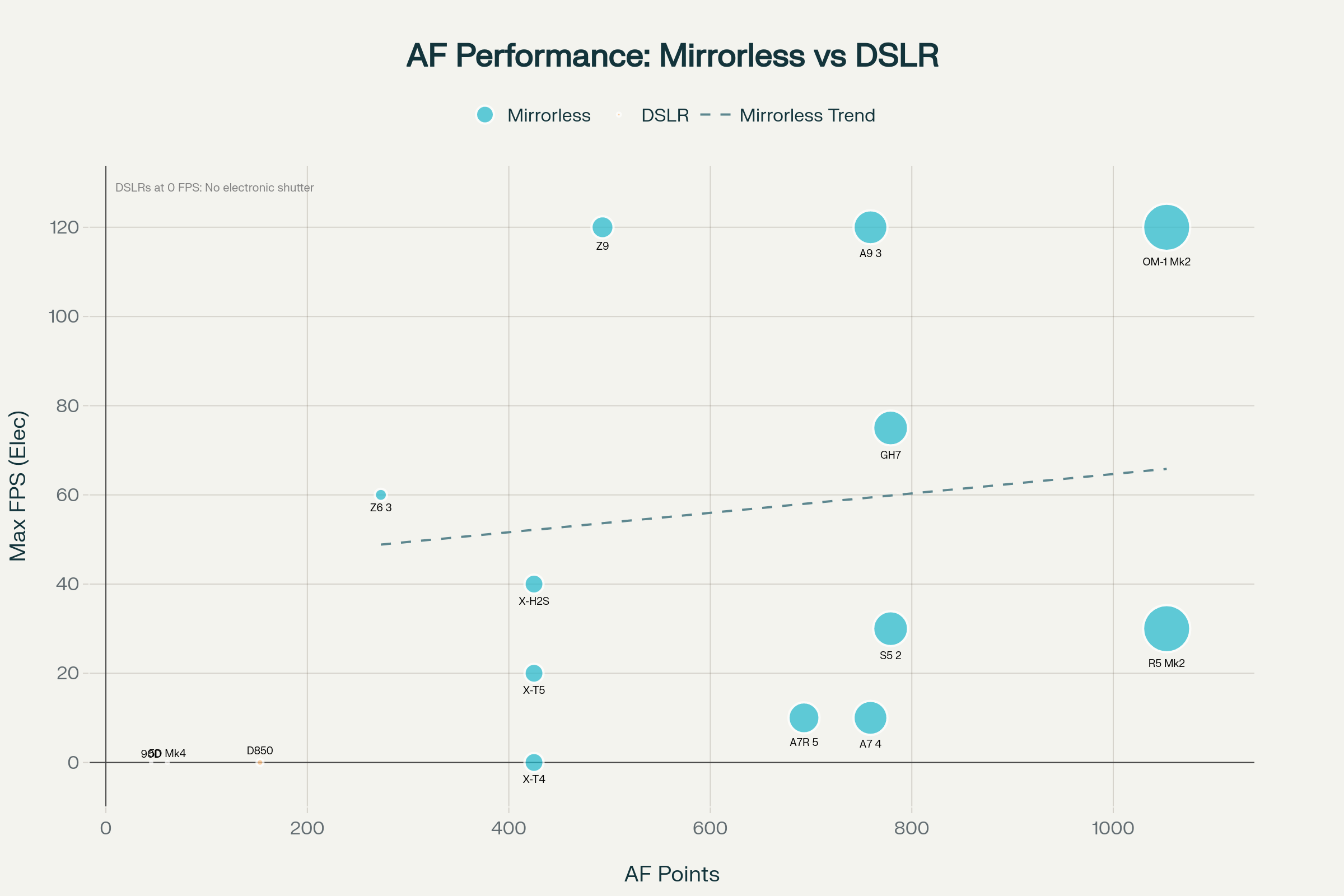
Autofocus Performance Analysis: AF Points vs Electronic Shutter Speed (2020-2025)
2.1.3 Benchmark Analysis: AF Tracking in the Real World
Reviews of flagship models released between 2020 and 2025 consistently highlight the superiority of mirrorless AF systems:
Canon EOS R3: The R3's autofocus is described as "ridiculously fast" and a significant leap beyond any previous Canon camera. Its subject tracking for sports is exceptionally "sticky," maintaining focus on an athlete even when they are temporarily obscured by other players.
Nikon Z9: The Z9 introduced a ground-breaking evolution in subject recognition. Unlike rivals that require the user to pre-select a subject type, the Z9's AI can automatically detect and differentiate between people, animals, and vehicles in the same scene without any user input.
Sony A1: As a pioneer in mirrorless AF, Sony's system in the A1 is exceptionally mature and reliable. With 759 PDAF points and the ability to perform 120 AF/AE calculations per second, its Real-Time Eye AF for humans and animals is a benchmark in the industry.
2.2 Speed, Responsiveness, and Endurance
The mechanical limitations of the DSLR's mirror assembly create a hard ceiling for performance metrics related to speed, while the electronic nature of mirrorless cameras unlocks new levels of responsiveness.
Continuous Shooting: The physical action of the mirror flipping up and down limits the continuous shooting speed of DSLRs. The fastest professional DSLRs, the Canon EOS-1D X Mark III and Nikon D6, top out at 16 fps and 14 fps, respectively, when using the optical viewfinder. In contrast, by leveraging their electronic shutters and fast sensor readouts, flagship mirrorless cameras can achieve staggering burst rates. The Canon R3 and Sony A1 can shoot at 30 fps, the Canon R6 Mark II at 40 fps, and the Nikon Z9 can capture 11-megapixel JPEGs at an astonishing 120 fps, all with continuous autofocus and auto-exposure tracking.
Viewfinder Blackout: During a burst sequence on a DSLR, the optical viewfinder experiences a period of blackout with each shot as the mirror flips up. This creates a stuttering effect that can make it difficult to track an erratically moving subject. The latest generation of mirrorless cameras with stacked CMOS sensors offer a completely blackout-free shooting experience in their EVFs.
2.3 Physical Characteristics and Performance Metrics
Comprehensive analysis of major camera models from 2020-2025 reveals significant differences in physical characteristics between DSLR and mirrorless systems:
Weight and Size: DSLRs average 865.3g in body weight compared to 715.8g for mirrorless cameras, representing approximately 17% weight savings in mirrorless designs.
Battery Life: However, battery life presents a significant advantage for DSLRs, with an average CIPA rating of 1,347 shots compared to 509 shots for mirrorless cameras. This disparity stems from the power-intensive nature of electronic viewfinders and continuous sensor operation in mirrorless systems.
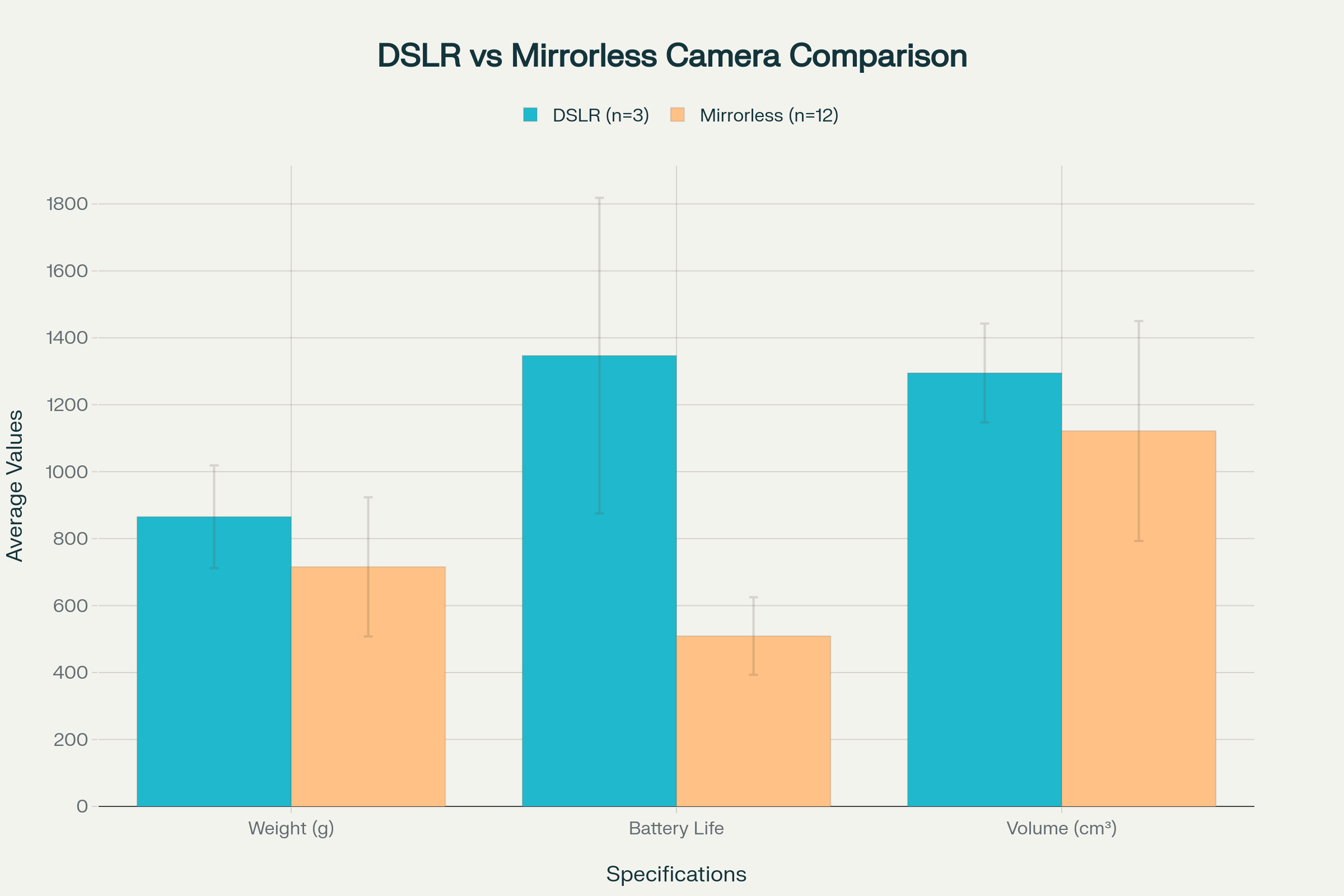
DSLR vs Mirrorless Camera Physical Characteristics Comparison (2020-2025)
The physical and performance specifications of key models released between 2020 and 2025 demonstrate the clear trajectory toward mirrorless dominance across all major manufacturers.
3. The Ecosystem: A System-Level Evaluation
A camera is more than just a body; it is the center of a complex ecosystem of lenses, accessories, and market forces. The choice between DSLR and mirrorless is therefore not just a technical one, but a strategic investment in a system.
3.1 The Lens Universe: Native Glass, Third-Party Support, and Adaptation
The selection of available lenses is a primary consideration for any photographer. Here, the long history of DSLRs provides a legacy advantage, while the modern design of mirrorless mounts offers a path to future optical excellence.
Mature DSLR Mounts (Canon EF, Nikon F, Pentax K): The primary strength of the major DSLR mounts is their sheer breadth and maturity. Decades of continuous production have resulted in an enormous catalog of lenses from both first-party and third-party manufacturers like Sigma and Tamron. This includes everything from affordable consumer zooms to exotic super-telephoto primes and specialized tilt-shift lenses. The secondhand market for these lenses is vast, liquid, and offers incredible value, making it easy for a photographer to build a comprehensive kit on a budget.
However, this is a purely legacy advantage. With the exception of Pentax, major manufacturers have ceased development of new lenses for their DSLR mounts, meaning the ecosystem, while large, is now stagnant.
Modern Mirrorless Mounts: This is where the entirety of the industry's research and development efforts are now focused.
Canon RF & Nikon Z: Launched later than Sony's full-frame system, Canon and Nikon have been aggressively building out their native lens lineups. The focus has been on producing optically exceptional, often premium-priced "L-series" (Canon) and "S-Line" (Nikon) lenses that showcase the optical advantages of the new mounts.
Sony E-Mount: As the first major full-frame mirrorless system, Sony's E-mount is the most mature and extensive. It boasts a massive selection of native Sony G Master lenses and benefits from broad and deep support from third-party lens makers.
L-Mount Alliance: A unique partnership between Leica, Panasonic, and Sigma, the L-Mount Alliance uses a shared, open lens mount standard. This gives users unprecedented flexibility, allowing them to pair, for example, a Panasonic Lumix S-series body with premium lenses from Leica or the extensive Art series lenses from Sigma.
The Role of Adapters: To ease the transition for their vast user bases, both Canon and Nikon produced high-quality lens adapters (the EF-EOS R and FTZ adapters, respectively) that allow their legacy DSLR lenses to be used on new mirrorless bodies. These adapters work exceptionally well for most modern lenses, preserving autofocus and image stabilization. They serve as a critical "bridge," allowing photographers to upgrade their camera body to gain the performance benefits of mirrorless technology while deferring the significant cost of replacing their entire lens collection.
3.2 The Secondary Market: Value, Liquidity, and Strategic Considerations
The used camera market provides a clear barometer of consumer demand and long-term value. Analysis of sales data reveals a decisive and irreversible shift in favor of mirrorless systems.
Market Data Analysis: According to sales data from major used equipment retailer KEH, a historic tipping point was reached in December 2020. For the first time, monthly revenue generated from the sale of used mirrorless cameras surpassed that of used DSLRs. This was not an anomaly but the start of a sustained trend. For the full year of 2020, revenue from mirrorless body sales grew by an explosive 91%, while revenue from DSLR bodies contracted by 6%.
Depreciation and Value Retention: The value proposition in the used market is now sharply divided. The average selling price of a used mirrorless camera is 78% higher than that of a used DSLR, and that gap continues to widen. The flood of photographers upgrading from DSLR to mirrorless has saturated the secondhand market with DSLR bodies, creating a strong buyer's market where high-quality, professional-grade equipment can be purchased for a fraction of its original cost.
Strategic Implications: This market dynamic presents a clear strategic choice for photographers. For a beginner or someone on a strict budget, the used DSLR market offers an unparalleled opportunity to acquire a highly capable camera and a wide range of affordable lenses. However, for professionals or enthusiasts looking to make a long-term system investment, purchasing a DSLR—even a new one—is no longer a sound strategy.
3.3 Market Share Evolution and Professional Adoption
Recent market data demonstrates the complete shift in industry dynamics:
Global Market Share (2023):
- Canon: 41.2% (primarily mirrorless)
- Sony: 32.1% (exclusively mirrorless)
- Nikon: 13.2% (transitioning to mirrorless)
- Fujifilm: 8.0% (exclusively mirrorless)
- Other brands: 5.5%
Professional photographer surveys indicate that mirrorless cameras now represent 63% of professional equipment choices, compared to 36% for DSLRs. This shift reflects the maturation of mirrorless technology and the introduction of professional-grade bodies like the Canon R1, Nikon Z9, and Sony A7R V.
4. Forward-Looking Innovations: The Next Frontiers in Digital Imaging
The mirrorless architecture is not merely a refinement of the DSLR; it is a new technological foundation. Its fully electronic nature enables a class of innovations in sensor technology and computational processing that are physically impossible to implement in a mechanical, mirror-based system.
4.1 The Sensor Revolution: Redefining the Point of Capture
The image sensor in a mirrorless camera is an active component, and its design is at the forefront of innovation.
Stacked CMOS Sensors: The development of the stacked CMOS sensor is one of the most significant imaging breakthroughs of the last decade. A conventional Back-Side Illuminated (BSI) sensor improves sensitivity by moving the wiring circuitry from the front of the photosites to the back, allowing for a greater light-gathering area. A stacked sensor takes this a step further by adding a separate layer of silicon directly bonded to the back of the sensor. This new layer contains high-speed processing circuits and its own integrated DRAM memory.
This architecture creates a much shorter, more direct signal path, dramatically increasing the sensor's readout speed. This leap in speed is the enabling technology behind the signature features of modern flagship cameras like the Sony A1, Nikon Z9, and OM System OM-1. It allows for blackout-free burst shooting at 20, 30, or 50 fps; vastly faster autofocus calculations (up to 120 per second); and a significant reduction in the "rolling shutter" distortion that can plague standard CMOS sensors when capturing fast motion with an electronic shutter.
Global Shutter Technology: The next frontier in sensor design is the global shutter. A standard CMOS sensor uses a "rolling shutter," reading out the image data line by line from top to bottom. If the subject or the camera moves during this readout process, it can lead to distortion artifacts where straight lines appear skewed or curved (the "jello effect").
A global shutter solves this problem entirely by exposing and reading out every single pixel on the sensor at the exact same instant. This freezes motion perfectly without any distortion. This technology made its debut in the consumer full-frame market with the Sony A9 III. A global shutter completely eliminates rolling shutter artifacts, but its most revolutionary impact is on flash photography. Because there is no moving shutter curtain, it allows for flash synchronization at any shutter speed, up to an incredible 1/80,000s on the A9 III, fundamentally changing the rules of mixing flash with ambient light.
4.2 The Ascendancy of Computational and AI-Driven Photography
The constant data stream from the sensor to a powerful processor transforms the mirrorless camera into a potent computational platform, enabling features driven by software and artificial intelligence.
The Role of AI in Autofocus: The integration of AI is the latest major revolution in autofocus systems. The mirrorless architecture is uniquely suited to this revolution. With direct access to the full image frame at high speed, processors like Canon's DIGIC X and Nikon's EXPEED 7 can run deep-learning neural networks that have been trained on vast datasets. This allows the camera's AF system to move beyond simple pattern and color detection to genuine subject recognition. The camera can identify a subject as a "bird," an "airplane," or a "human face," and apply specific tracking parameters optimized for that subject's likely behavior.
Computational Imaging Techniques: Mirrorless cameras are increasingly leveraging their processing power to create images that would be impossible to capture in a single shot:
- Pixel Shift High-Resolution Mode: Uses the IBIS unit to physically shift the sensor by a single pixel increment between exposures, compositing multiple shots into a single file with significantly higher resolution and more accurate color rendition.
- In-Camera Focus Stacking and Bracketing: Many mirrorless cameras can automate the process of focus bracketing, rapidly taking a series of photos while shifting the focus point through the scene.
This evolution from a mechanical-optical device to a solid-state computational platform is the most profound consequence of the mirrorless design. A DSLR's core functionality is defined by its hardware and is largely fixed at the time of manufacture. A mirrorless camera's capabilities, in contrast, are increasingly defined by its software and processing power.
5. Market Analysis and Future Projections
5.1 Current Market Dynamics
The mirrorless camera market was valued at USD 4.4 billion in 2024 and is projected to reach USD 10.6 billion by 2037, growing at a CAGR of 6.4% during the forecast period. This growth is driven by several key factors:
Regional Market Distribution:
- Asia Pacific (excluding Japan): Commands a dominant 50.1% share during the forecast period
- North America: Defined by high professional adoption and fast-growing enthusiast segment
- Europe: Strong retail infrastructure and innovative technology adoption
Sensor Type Market Share:
- APS-C sensors: Anticipated to maintain 47.2% of the mirrorless camera market
- Full-frame sensors: Growing rapidly in professional and enthusiast segments
- Micro Four Thirds: Established niche with strong ecosystem support
5.2 Technology Adoption Trends
Current technological trends show mirrorless systems leading in virtually all advanced features:
AI Integration: 77% of manufacturers now use AI in production and autofocus systems
IoT Adoption: 62% use IoT for asset tracking and predictive maintenance
Sustainability: Major brands adopting green design and recycled materials
5.3 Supply Chain and Manufacturing Evolution
The global mirrorless camera market has witnessed ongoing supply chain transformation due to semiconductor shortages and geopolitical conflicts. Leading manufacturers have adopted several strategies:
Sony: Diversified semiconductor sourcing across Japan, South Korea, and Taiwan, achieving 20-40% increase in working capital
Canon: Implemented closed-loop recycling with resource recycling rate increased to 17%
Nikon: Resolved procurement constraints with revenue up ¥48.9B and operating profit up ¥23.2B YoY
6. Performance Comparison Matrix
| Feature | DSLR | Mirrorless | Advantage |
|---|---|---|---|
| Weight | 865g avg | 716g avg | Mirrorless (-17%) |
| Battery Life | 1,347 shots | 509 shots | DSLR (+164%) |
| AF Points | 45-153 | 1,000+ | Mirrorless |
| Max FPS | 12-16 | 120 | Mirrorless |
| Viewfinder Lag | 0ms | <10ms | DSLR |
| Lens Options | 180-190 | 50-100 | DSLR |
| Future Tech | Limited | Leading | Mirrorless |
| Market Growth | Declining | +6.4% CAGR | Mirrorless |
7. Conclusion and Strategic Outlook
The comparative analysis of DSLR and mirrorless camera systems, grounded in architectural principles, performance benchmarks, ecosystem dynamics, and technological innovation, leads to an unequivocal conclusion. The transition from DSLR to mirrorless is not a matter of preference or a cyclical trend; it represents a fundamental and irreversible technological supersession, akin to the shift from film to digital.
7.1 The Verdict
The debate over which system is superior is, for all practical purposes, concluded. From the perspectives of engineering efficiency, performance potential, and future market viability, the mirrorless architecture has proven to be decisively superior. The removal of the reflex mirror assembly has unshackled camera design from the mechanical constraints that defined the DSLR era, enabling the creation of smaller, faster, quieter, and more intelligent imaging devices.
7.2 The Future Trajectory of DSLRs
The DSLR market has now firmly transitioned from mainstream to niche. The platform will continue to exist, supported by the vast and highly affordable secondary market for bodies and lenses, and catering to a small but dedicated user base of purists who prefer the unmediated experience of an optical viewfinder. With the exception of Ricoh's Pentax brand, which has strategically committed to serving this niche, all major manufacturers have ceased R&D and production of new DSLR models.
7.3 The Unassailable Momentum of Mirrorless
All significant investment and innovation in the interchangeable-lens camera industry is now exclusively concentrated on the mirrorless platform. The future of imaging performance lies in the continued advancement of sensor technology (stacked CMOS, global shutters), processing power, and AI-driven software. These are frontiers that are only accessible to the fully electronic, computational architecture of mirrorless cameras.
7.4 Final Recommendations
For Professionals and Serious Amateurs: An investment in a DSLR system is no longer a strategically sound long-term decision. For those working in performance-critical fields such as sports, wildlife, or photojournalism, a migration to a modern mirrorless system is essential to remain technologically competitive.
For Beginners and Budget-Conscious Hobbyists: The used DSLR market represents an unprecedented value proposition. It is possible to acquire a highly capable, professional-grade camera body and a selection of excellent lenses for a fraction of the cost of a new mirrorless equivalent. However, for those seeking a system to grow with over the next decade, a modern entry-level or mid-range mirrorless camera is the more forward-looking and future-proof investment.
The performance gap that exists today will only continue to accelerate as mirrorless technologies mature. The debate is over—the future of digital imaging belongs entirely to the mirrorless architecture.
Key Data Sources:
- Camera and Imaging Products Association (CIPA) shipment data
- Market research from Virtue Market Research and Research Nester
- Technical specifications from major manufacturers (Sony, Canon, Nikon, Fujifilm, Panasonic)
- Professional photographer adoption surveys
- Secondary market analysis from KEH and other major retailers